 A stroll in a park can lead to exciting discoveries.
When you enter a park, what do you see? Trees? Obviously. Mosquitoes? Lots of them. Maybe a few birds? Yes. Anything interesting? Not really.
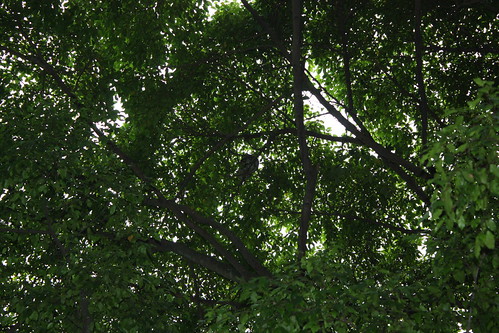
Why not look up at a tree, like the one above, shot in West Coast Park? What do you see? Leaves? Duh. What else?
The sky... and... wait a minute... What is that thing in the middle of the picture?
Lets move to a different angle shall we?
 Hmm... Still not clear enough? Ok then. Lets stop torturing your eyes on the above picture and look at the shot below.
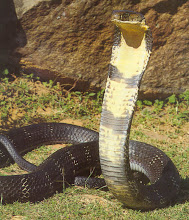
 Yikes! A snake! Not just any old snake, its the Reticulated Python. Also known as Python reticulatus. The world's longest snake and obviously, also the longest of all reptiles, reaching up to about 8.7 m long. However, they are relatively slim for their length and are certainly not the most heavily built.
The colour pattern is a complex geometric pattern that incorporates different colours. The back typically has a series of irregular diamond shapes which are flanked by smaller markings with light centers. In this species' wide range, much variation of size, colour, and markings commonly occurs.
In zoo exhibits the colour pattern may seem garish, but in a shadowy jungle environment amid fallen leaves and debris it allows them to virtually disappear. Called a disruptive colouration, it protects them from predators and helps them to catch their prey.
This nocturnal snake is both terrestrial and arboreal, catching small mammals and birds, and strangling them before swallowing them whole.
Reticulated Pythons can be found in most habitats from forest to mangroves, and often near human habitation.
They are capable of overpowering a person, so my advice to you is not to go near one if you ever meet one.


 These dragonfly pictures are taken in my school. All of them are called the Slender Skimmer.
 The snake you are staring at now is called the Paradise Tree Snake. I found this beauty along the entrance of Sungei Buloh, chewing on a yummy gecko. If you want to see it without travelling far, you can look for it in your garden. This creature can be found everywhere in Singapore, even in urban gardens. It is mildly venomous and feeds mainly on lizards and small birds, and is also capable of gliding. Some individuals, like this one, have red 'flower' pattern along the middle of the back.
 This Singapore Tarantula was shot at West Coast Park. If you observe closely, you can see the tiny hairs on its body. You can see that it has lined its lair with web.
 Before I make my way home, my friend lifted up a small piece of wood. We found this cute Banded Bullfrog underneath it.
 This little guy was spotted in my school. Its quite small. My friend spotted it and we took some pics.
 I found this Asian Koel dead. I was on my way home from Jurong Bird park. There were ants surrounding it. There was a hole where the eye was supposed to be. This proved that the bird had been dead for a few hours.
 My brother threw a mealworm at the ants. You might not see the mealworm in this picture...
 My rat clinging onto my arm. Trust me, he is better now. He is now able to climb up my arm and onto my shoulder.
  "What is that strange flash of light?"
 "Interesting articles..."
 Examining the sofa after 'reading' the newspaper.
  "Oops... There is a spot on my fur. Time to groom myself."
 "Is that irritating flash of light again! Wonder what that human is doing."
 The first thing I saw was a Clouded Monitor. It was foraging for food. When it saw me, it quickly crawled into the vegetation.
 I saw it moving on this twig. I took a shot of it. If you look closely, you can see its wings.
  My father spotted this Golden Web Spider. This spider seems to be very common in forested and urban areas.
 I was looking at two Common Treeshrews when this Greater Racket-tailed Drongo flew in front of me. Can you see the two hanging feathers at the end of the tail. This bird is sometimes seen with only one or no feathers hanging from the tail.
 While taking shots of the Greater Racket-tailed Drongo, this woodpecker flew onto a tree close to me. I could not get a clear picture of it as it was flying from tree to tree.
 While walking, I was thinking if I would find a Malayan Whip Snake at the same spot I found one few days ago. I looked carefully around the vegetation and Bingo! I found a Malayan Whip Snake.
 Take a closer look at its head. The eyes of this snake distinguishes itself from its common cousin the Oriental Whip Snake. For a picture of the Oriental Whip Snake, visit
  I spotted this ant hill on a plant. Normally you see ant hills on the ground, but this was built on a plant, about 1m above the ground.
 Before leaving Bukit Timah, my father found this Common Sun Skink on a log. A few visitors to the Bukit Timah were also looking at it.
 I expect this dog was sniffing for food when I saw it. It quickly ran into the woods after seeing me approaching it.
 A Long-tailed Macaque in the middle of the road. The macaques found around the reservoir were all afraid of humans, unlike the ones in Bukit Timah Nature Reserve. This is a good sign. It showed that no one fed the macaques that lived around the reservoir.
  Can you spot the yellow dragonfly in this picture? I saw it flying around and grabbed the chance to take a photo of it resting.
 The dragonfly on this tree bark was well camouflaged. Can you spot it?
 This spider jumped in front of me. At first I thought it was an ant. After examining it, I realised that it was a spider. I do not know the name of this spider as I did not see it or read about it before. This was my first time seeing it.
 I heard a cicada singing on a tree branch. When I approached the cicada, it suddenly flew and landed among the grass(circled). Can you spot it? Find for the red circle. (You might not be able to spot the circle too.)
  My father spotted this tiny creature on a stone table. It looked like a spider but my book does not say anything about it. It might also be a pseudoscorpion.
 An orange cicada. Spotted it flying. Its abdomen was a beautiful red in colour. It landed on this leaf and I managed to take a photo before it flew away.
 A brown praying mantis among the leaf litter. Saw it hopping around. It might be a Dead Leaf Mantis. I expect it hopped around for lunch before going back into hiding.
  While on my way out of the reservoir, I spotted a Green Crested Lizard. This creature used to be a common tree lizard in urban gardens, but lost competition to the Changeable Lizard. Now it can only be found in wooded areas.
 The lizard saw me and ran into the vegetation. It turned brown. Can you spot it?
 The first thing I saw hopping along was a Banded Bull Frog. This nocturnal insectivore is common even in urban areas.
  We continued our way to the Mangrove Broadwalk and saw these mudskippers together. Some even rolled over in puddles of water. Cute!
 This little crab was about to hide into a hole dug by itself. Look at the pincers. There is a big difference in size.
 A whole gang of crabs.
 A Nipah plant.
 This little crab digs holes too. According to someone, this is a Sand Bubble Crab. Quite small in size.
 The spider which made this web is a good web artist.
 Can you spot the camouflaged mudskipper?
 This Mud Crab is the biggest crab I have seen today.
 This crab has beautiful colours. This is the nicest crab I have seen today.
  Another crab with different size pincers.
 A Malayan Water Monitor. This creature is among the largest lizard in the world. It can climb trees and is also an expert swimmer and diver. It feeds on small animals and fish.
 A shot of a Yellow-lined Epeus. This spider can grow around 9mm. It can be found in heavily wooded gardens or mangrove swamps.
 Can you spot the grasshopper in this picture? The actual size is about 6cm.
 A crab pulling a leaf. Wonder what is it going to do with the leaf. Eat it? Or is it going to lay its eggs on it so the young can feed on it?